
 Publish date: 29 December, 2025
For most founders, the conversation around diversity starts the same way: late, usually under pressure, and rarely because it was part of the original plan. It tends to surface after a resignation, a stalled team, or a moment when delivery slows down for reasons that don’t show up in Jira.
What becomes clear over time is that inclusion shows up less in statements and more in numbers. Across European labour studies, teams with a more balanced gender and cultural mix report 15–20% lower voluntary turnover than less diverse peers (McKinsey, Diversity Wins; Eurofound, 2023). In practical terms, that means fewer rehiring cycles, less context loss, and more continuity in delivery—especially as teams scale beyond the first 20 or 30 engineers.
There is a similar pattern under pressure. Research consistently shows that mixed teams produce a wider set of solution paths when faced with complex problems (Harvard Business Review, How Diversity Can Drive Innovation). For founders, this matters most when timelines compress and the cost of choosing the wrong solution rises. Broader problem-solving reduces the risk of locking into the first acceptable answer simply to move on.
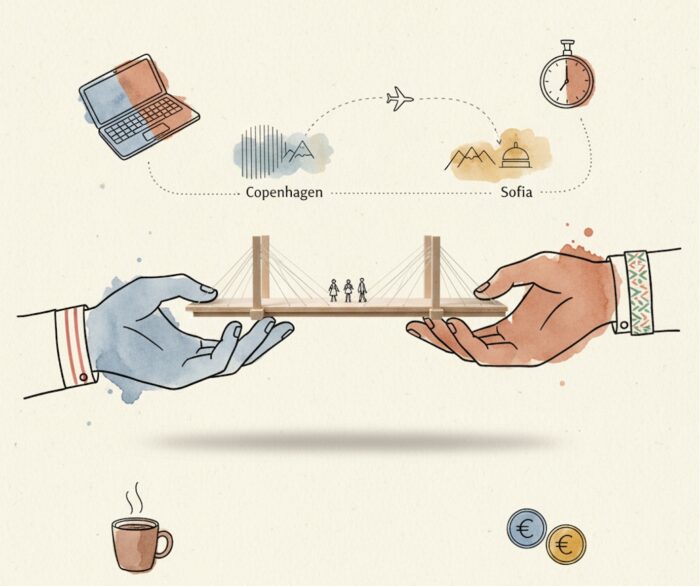
When Danish structure meets Bulgarian inclusivity, teams often settle into a rhythm that supports sustained output. Velocity stays high, but volatility drops. Ambition remains, but execution is less fragile. These effects rarely appear in the first sprint; they become visible six to nine months in, when early momentum gives way to operational reality.
Equity and Trust as Operational Systems
Denmark’s tradition of flat hierarchies and transparent governance aligns closely with Bulgaria’s culture of technical ownership. In practice, this combination reshapes how teams function day to day.
Decision rights tend to sit closer to the work. Engineers are evaluated on outcomes rather than proximity to headquarters or visibility in meetings. Studies on distributed engineering teams link clearer ownership structures to faster issue resolution and lower coordination overhead (MIT Sloan Management Review, 2022).
From a founder’s perspective, the effect is cumulative. Trust reduces the need for oversight. Equity reduces internal politics. Inclusion lowers the likelihood of disengagement that usually surfaces months later as missed milestones or unexpected attrition. None of this is abstract. It shows up in delivery predictability and in how much managerial attention is consumed by internal friction rather than product decisions.
What emerges over time is operational trust: teams move faster because less energy is spent managing uncertainty inside the system.
A Broader European Advantage
The inclusion effect is not a side consideration in nearshore hiring; it is one of the conditions that determines whether the model scales cleanly or accumulates hidden costs.
Europe continues to face a structural shortage of digital talent. Eurostat data shows persistently high ICT vacancy rates across member states, alongside rising time-to-hire in Northern Europe since 2021. In this environment, ecosystems that combine inclusion with performance expand the available talent pool and sustain it longer.
Bulgaria’s position as the EU leader in female participation in ICT roles, with close to one in three engineers being women (Eurostat, 2023), materially changes the supply equation for Danish companies aiming to build balanced teams without extending hiring cycles or compromising standards.
For founders, the implication is straightforward. Teams built with a broader range of perspectives adapt faster, distribute stress more evenly, and recover more quickly from setbacks. That resilience rarely appears in pitch decks, but it becomes visible over time—in runway math, delivery cadence, and investor confidence.
In Europe’s next phase of tech growth, inclusion functions less as a headline and more as infrastructure. It is one of the factors that allows companies to keep shipping at speed while maintaining trust—internally and externally.
And in a market where speed is a feature but trust is the platform, that operating advantage compounds quietly, long after the org chart is filled.