
 Publish date: 24 February, 2026
The Article in 30 Seconds
- Denmark’s data centre market valued at USD 1.5–1.8 billion in 2024, projected to reach USD 2.9–3.5 billion by 2030.
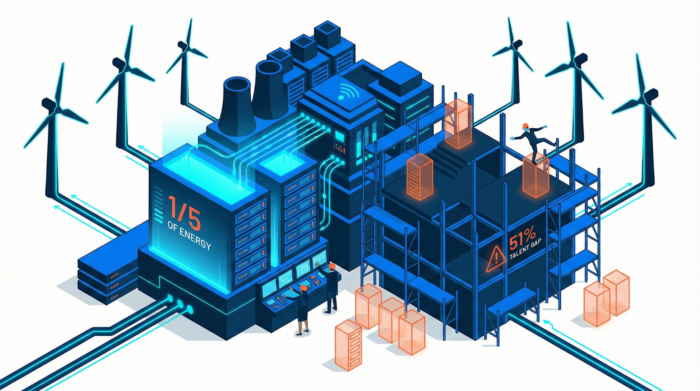
- Data centres could consume one-fifth of Denmark’s total energy budget by 2030 (Danish Energy Agency).
- Microsoft announced a multi-billion USD investment in West Denmark in December 2025—its largest in Denmark.
- 51% of data centre operators globally reported difficulty finding qualified candidates in 2024 (Uptime Institute).
- Demand is shifting to infrastructure engineers, SREs, security specialists, and cooling/efficiency experts.
In December 2025, Microsoft announced its largest investment in Denmark: a multi-billion USD datacenter region in West Denmark, adding to its existing Denmark East region launching in early 2026. The announcement followed a pattern: Apple, Meta, Google, and Digital Realty have all expanded their Danish footprints. Copenhagen now ranks as the third largest AI ecosystem in the EU.
But behind the investment headlines sits a constraint that press releases rarely mention: finding the people to build and run these facilities.
The Energy Equation
According to the Danish Energy Agency’s 2024 projections, data centres will account for one-fifth of Denmark’s total energy budget by 2030. The projections for capacity needed towards 2040 have doubled compared to expectations from 2023.
Denmark offers what data centre operators need: access to renewable energy (approximately 80% of the energy mix), well-developed power grid infrastructure, international data cables, and district heating systems that can absorb excess heat. The government recently agreed to remove pricing caps on excess heat from data centres, making heat recovery economically viable.
In 2025, Danish data centres are expected to consume 3,600 GWh annually—approximately one-tenth of Denmark’s total electricity consumption. The International Energy Agency projects Denmark’s data centre electricity demand could increase sixfold by 2030.
The Talent Constraint
Infrastructure expansion requires people. According to the Uptime Institute’s 2024 Data Center Staffing Survey, 51% of data centre operators globally reported difficulty finding qualified candidates. The biggest shortfalls were in junior and mid-level operations (39%), electrical roles (33%), operations management (32%), and mechanical positions (30%).
The challenge is not simply the absolute number of workers available. Data centres are expanding at the same time that utilities, manufacturing, renewables, grid infrastructure, and construction all compete for the same skilled labour pool. AI workloads amplify this pressure – they require specialised power systems, advanced cooling, and different maintenance skills than traditional servers.
A 2025 PwC report found the data centre industry contributed 4.7 million jobs to the US economy in 2023—a 60% increase from 2017. The pattern is global.
The Role Shift
AI infrastructure is changing what data centres need to hire. Traditional facilities often use 5–10 megawatts of power. AI-driven facilities may need 50–100 megawatts or more. This creates demand for specific competencies:
- Infrastructure and reliability engineering: Site Reliability Engineers (SREs) who blend software-oriented automation with traditional IT operations. Professionals who can bridge engineering, automation, and cloud platform reliability are rare.
- Power systems expertise: Engineers who understand high-density power systems, renewable energy integration, and high-voltage design. The shift to AI workloads makes electrical distribution skills critical.
- Cooling and efficiency: The data centre cooling market was valued at approximately USD 20.8 billion in 2025 and is projected to reach USD 49.9 billion by 2034. Liquid cooling for AI infrastructure requires different skills than traditional HVAC.
- Security specialists: As data privacy regulations tighten and cloud migration accelerates, cybersecurity and network defence become essential.
The Implication for Hiring Strategy
For Danish tech companies, the data centre surge creates both competition and opportunity. Competition: the same talent pool that startups need is being pursued by hyperscalers with larger budgets. Opportunity: proximity to expanding infrastructure creates demand for adjacent skills – and potential career paths for developers interested in reliability, security, and systems work.
The infrastructure boom is not abstract. It is happening in Esbjerg, Varde, Sønderborg, and greater Copenhagen. The companies that can source and develop infrastructure talent – вhether locally or through nearshore partnerships – will have an advantage as compute demand continues to grow.
Questions & Answers
How large is Denmark’s data centre market?
Market research estimates vary: USD 1.53–1.76 billion in 2024, projected to reach USD 2.93–3.51 billion by 2030, representing a CAGR of 11–12%.
What share of Denmark’s energy will data centres consume?
According to the Danish Energy Agency’s 2024 projections, data centres will account for one-fifth of Denmark’s total energy budget by 2030. The IEA projects Denmark’s data centre electricity demand could increase sixfold by 2030.
Which companies are investing in Danish data centres?
Microsoft announced a multi-billion USD investment in West Denmark in December 2025. Other operators active in Denmark include Apple, Meta, Google, Digital Realty, GlobalConnect, STACK Infrastructure, and Bulk Infrastructure.
What roles are hardest to fill in data centres?
According to Uptime Institute’s 2024 survey, the biggest shortfalls are in junior/mid-level operations (39% of operators reporting difficulty), electrical roles (33%), operations management (32%), and mechanical positions (30%).
How does AI change data centre staffing needs?
AI facilities require more power (50–100 MW vs 5–10 MW for traditional facilities), advanced liquid cooling, and GPU maintenance skills. This creates demand for specialised electrical engineers, SREs, cooling technicians, and security specialists.
Sources: Danish Energy Agency 2024, IEA, Uptime Institute 2024 Data Center Staffing Survey, Microsoft December 2025 announcement, market research from NextMSC and ResearchAndMarkets.