
 Publish date: 21 January, 2026
The article in 30 seconds
Picture your 2026 planning meeting: the roadmap looks sharp… until someone asks the only question that matters – “And who’s actually going to build this?”
Europe’s talent gap is still the quiet constraint. The EU had 10.3m ICT specialists in 2024, still ~9.7m short of the 2030 target, and 57.5% of companies trying to hire ICT talent report difficulty filling roles.
In Denmark, the reality shows up in outcomes: STAR’s data from March – August 2025 found recruitment challenges in 23% of attempts (11% no hire, 12% partial fit).
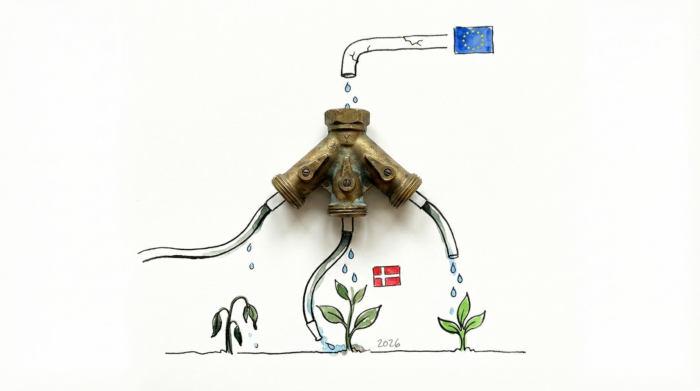
The punchline for 2026: stop betting your roadmap on one labour market. Build capacity you can count on – a local pipeline plus a nearshore portfolio that reduces hiring latency without rolling the dice on global outsourcing.
The most underappreciated competitive advantage in 2026 won’t be a new AI feature or a clever go-to-market tweak. It will be the ability to build capacity predictably. With Europe still short of key digital skills, Danish companies are increasingly moving toward nearshore “portfolios” – not as a cost play, but as a way to stop roadmaps being held hostage by a tight labour market.
The “EU talent gap” can sound like a Brussels phrase. In practice, it shows up as something very concrete in Copenhagen: roles that take longer to fill, a wider spread in candidate quality, and an uncomfortable amount of leadership time spent babysitting hiring.
The context: Europe is still tight where it matters
At a high level, the labour market hasn’t magically loosened. Eurostat puts the EU job vacancy rate at 2.0% in Q3 2025, with Denmark (restricted coverage) at 2.3%.
And the slice most relevant for tech-led businesses remains tight too: in Information & Communication, the EU vacancy rate was 2.2% in Q3 2025.
That’s the macro frame. The micro reality in Denmark is more blunt. Denmark’s labour authority (STAR) analysed recruitment outcomes using data collected March–August 2025 and found recruitment challenges in 23% of attempts – with 11% ending in no hire and 12% filled by someone missing desired qualifications.
For a founder, those are not “labour market” numbers. They’re delivery-risk numbers.
Why the “gap” is still relevant for 2026
Three forces keep this structural.
Demographics don’t hurry. Eurostat projects the EU population peaks around 2026, then gradually declines – a slow but persistent constraint on labour supply.
The ICT workforce is behind target. Eurostat reports 10.3 million ICT specialists employed in the EU (2024) and notes this is ~9.7 million below the EU’s 2030 Digital Decade goal.
Hiring ICT talent remains difficult. Eurostat reports that among enterprises that recruited or tried to recruit ICT specialists, 57.5% had difficulties filling vacancies (reported in 2024, referring to 2023 activity).
The Commission has been increasingly explicit that these shortages are persistent – including “widespread shortages” for ICT specialists – and ties this directly to the Digital Decade human capital targets.
None of this means “every tech role is scarce” in the same way. It does mean that for the roles that keep roadmaps moving – senior engineering, platform, security, certain data profiles – the market remains structurally less forgiving than most quarterly plans assume.
What this means for Danish hiring plans in 2026
The practical implication is not to double down on local hiring with more hope and bigger LinkedIn budgets.
It’s to stop treating hiring as a single-thread plan.
STAR’s figures – 11% no hire, 12% partial-fit across March – August 2025 – are a good reminder that “we’ll hire someone” is not a dependable dependency.
A more robust approach looks like a portfolio: multiple capacity paths that reduce your exposure to any one labour market constraint.
Why “nearshore portfolios” are becoming normal – and why that’s not the same as global outsourcing
Nearshoring has become less a trend and more a default risk-management move for many European teams: demand for IT outsourcing is explicitly linked to digitalisation pressure and the difficulty of hiring locally.
But there’s an important distinction worth making:
- A nearshore portfolio is typically built around proximity (time zone, travel, cultural compatibility), clear ownership, and delivery metrics. It’s “distributed team building”, not “throw it over the wall”.
- Global outsourcing, in its more familiar form, often optimises for low headline cost and high utilisation – which can be fine for well-specified work, but is frequently painful for fast-moving product teams where context changes weekly.
Danish teams tend to be good at the parts that make nearshore work: clarity, directness, process discipline, and a preference for trust over theatre. The challenge is operationalising it.
How to build capacity without gambling (a 2026 playbook)
If you want this to feel like a deliberate operating model – not an experiment that accidentally became permanent – a few principles help:
1) Keep “core” genuinely core.
Product ownership, architecture direction, domain-critical decisions – close to the business.
2) Nearshore repeatable throughput and reliability work.
Feature delivery with crisp definitions, QA automation, platform reliability, integration work – the areas where “done” can be measured.
3) Start with scope, not headcount.
One team, one domain, a short horizon (6–8 weeks). Expand only when the metrics hold.
4) Invest in onboarding as an asset.
In a tight market, switching is expensive. Faster time-to-productivity becomes a competitive advantage.
5) Run it as a portfolio.
Local hiring pipeline + a nearshore team + specialist support (security/data) usually beats a single heroic plan that breaks the first time a candidate declines.
The 2026 takeaway
The EU talent gap doesn’t mean Danish teams can’t hire. It means they shouldn’t build a roadmap that depends on hiring behaving like a certainty.
In 2026, the edge is less about “who hires best” and more about who builds capacity with redundancy – without rolling the dice on global outsourcing.
Q&A
Is there still a tech talent shortage in the EU in 2026?
Yes – especially for ICT roles. The EU had 10.3m ICT specialists in 2024, still ~9.7m below the 2030 Digital Decade target.
Why is it still hard to hire senior engineers in Europe?
Because many companies still struggle to fill ICT vacancies: Eurostat reports 57.5% of enterprises that recruited or tried to recruit ICT specialists had difficulties filling roles (reported in 2024, referring to 2023).
What’s the latest EU job vacancy rate, and what does it say about hiring pressure?
Eurostat reports the EU job vacancy rate was 2.0% in Q3 2025; Information & Communication was 2.2% – a sign that demand still outpaces supply in key sectors.
Denmark job vacancy rate 2025 – is it really 2.3%?
Eurostat reports Denmark at 2.3% in Q3 2025, but flags it as restricted coverage (business economy B–N). It’s valid as a Denmark indicator, but not perfect for strict cross-country comparison.
How often do Danish companies fail to hire at all?
STAR’s recruitment outcomes (data from March–August 2025) found recruitment challenges in 23% of attempts: 11% ended with no hire, and 12% were filled with a candidate missing desired qualifications.
What should we change in our 2026 hiring plan if the market stays tight?
Don’t rely on a single labour market. Build a capacity portfolio: local hiring + nearshore team + specialist bench, so one blocked role doesn’t block the roadmap.
Nearshore vs outsourcing – what’s the difference for a product company?
Nearshore portfolios are typically built for predictability (proximity, tighter feedback loops, easier travel, clearer accountability). Global outsourcing often optimises for low headline cost and utilisation, which can be risky when product context changes weekly.
How do we start nearshore without risking quality?
Start small: one team, one scope, 6–8 weeks. Define success metrics (cycle time, defect rate, predictability), invest in onboarding, and scale only when the metrics hold.
What’s the one-sentence takeaway?
In 2026, the edge is capacity you can count on – not a roadmap that assumes hiring will magically be smooth.