
 Publish date: 30 January, 2026
Why the best distributed teams run on rituals, not enthusiasm-and how Danish founders are getting it right
A Danish CTO once joked that managing a remote team is like marriage: the honeymoon ends, and then you need systems. He wasn’t wrong. The initial excitement of hiring brilliant engineers at a fraction of Copenhagen salaries fades quickly when PRs languish, standups turn into status theatre, and “async” becomes code for “ignored.”
The Danish founders who fail at scaling engineering teams across borders almost always fail for the same reason: they assume that hiring good people is enough.
It isn’t.
The difference between a distributed team that ships and one that stalls isn’t talent-it’s operating rhythm. The companies that succeed treat remote integration as a system design problem, not a hiring problem.
Here’s what actually works:
The One-Hour Advantage
Before discussing rituals, consider the structural gift of the Denmark–Bulgaria corridor: a single hour of timezone difference.
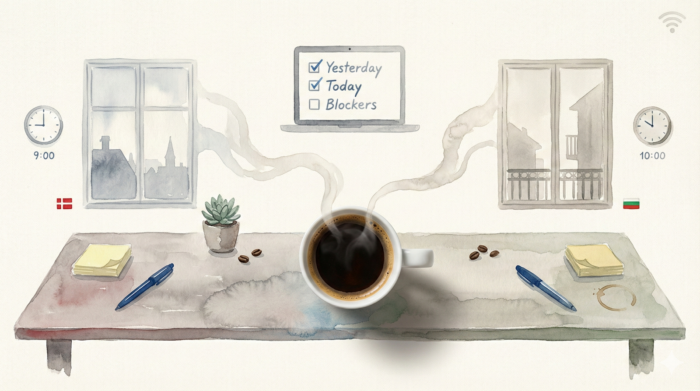
Copenhagen at 9:00 is Sofia at 10:00. This isn’t a minor detail-it’s a strategic asset. Unlike teams stretched across continents, the corridor offers full overlap of working hours. Real-time collaboration is the default, not the exception.
But overlap alone doesn’t create integration. Co-located teams in the same office can feel more disconnected than well-run distributed ones. The difference is deliberate design.
The Minimal-Overhead Operating Model
Nordic work culture has a particular character: flat hierarchies, trust-based autonomy, and an allergy to unnecessary process. Any operating model for distributed teams needs to honour that, not fight against it.
The goal isn’t more meetings. It’s the right rituals at the right cadence-enough structure to maintain alignment, not so much that it kills flow.
Daily Standup: 15 Minutes, Non-Negotiable
The daily standup is the heartbeat of a distributed team. But it has to be genuinely brief.
Format that works: each person answers three questions in under two minutes. What did I finish? What am I working on? What’s blocking me? Then done.
Timing matters. Mid-morning Copenhagen time-say, 9:30 or 10:00-catches everyone in their productive zone. The Sofia team is already warmed up; the Danish team hasn’t yet disappeared into deep work.
One rule that makes a real difference: cameras on. Not for surveillance, but for presence. Remote teams that default to audio-only slowly drift into feeling like contractors rather than colleagues. Seeing faces builds the ambient awareness that co-located teams get for free.
Code Review Cadence: The 24-Hour Rhythm
Code review is where distributed teams either build trust or breed resentment.
The failure mode is predictable: PRs sit in limbo for days, blocking work and signalling that remote contributions are second-priority. The fix is a simple commitment-every PR gets a first review within 24 hours.
This doesn’t mean instant responses. It means reliable ones. Engineers can plan around it. Work flows.
Pair the time commitment with clear review norms: what constitutes approval, when to request changes, how to handle disagreements. Write it down. A two-page code review guide, agreed by the whole team, prevents more friction than any number of sync meetings.
Cross-location review is particularly valuable. Danish engineers reviewing Bulgarian code and vice versa builds technical trust faster than any team-building exercise.
Async by Default, Sync When It Matters
The trap many teams fall into: treating every question as urgent, pinging colleagues constantly, expecting immediate responses. This kills deep work and burns out the best people.
Better approach: async is the default. Slack messages and comments don’t require instant replies. Questions that aren’t blocking go in writing, where they can be answered thoughtfully during the recipient’s chosen time.
Reserve synchronous communication for what actually needs it: complex technical discussions, ambiguous requirements, interpersonal issues, and celebrations.
One practical tool: the “office hours” model. Each senior engineer or team lead blocks a recurring hour each week-open to anyone who wants to join for questions, pairing, or unstructured discussion. It’s available but not mandatory. People use it when they need it.
The Onboarding Buddy System
The first 30 days determine whether a new hire integrates or drifts. For remote employees, this window is even more critical-and more fragile.
The onboarding buddy system is simple: every new hire is paired with an existing team member from the other location. A Bulgarian developer joining the team gets a Danish buddy; a Dane gets a Bulgarian one.
The buddy isn’t the manager. They’re a peer whose job is to be available: answer the questions that feel too small to ask formally, explain the unwritten norms, make introductions, and generally ensure the new person doesn’t feel lost.
Expectations should be explicit. Daily check-ins for the first week, then tapering to twice weekly, then weekly through month two. After that, the relationship becomes organic-but by then, the foundation is set.
The cross-location pairing is deliberate. It immediately builds a personal connection across the distance and signals that the team is genuinely integrated, not just administratively combined.
Cultural Calibration
Danish work culture has specific characteristics that can confuse people from other contexts-and vice versa.
The flat hierarchy is real but can be misread. When a Danish manager asks “what do you think?” they genuinely want to know. This isn’t a test or a formality. Engineers from more hierarchical backgrounds sometimes hesitate to speak up; they need explicit encouragement that their input is expected, not just tolerated.
Conversely, Danish directness in feedback can land harder than intended. “This approach won’t work” isn’t meant as harsh criticism-it’s just efficient communication. But for someone unused to it, context helps: “We’re direct with feedback here because we trust each other to handle it.”
The concept of tillid-trust-is foundational to Nordic business culture. It means autonomy and accountability in equal measure. Remote team members who demonstrate reliability earn increasing independence. Those who require constant oversight don’t fit the model.
Small rituals build cultural coherence. Some teams do virtual Friday afternoon hygge-casual video calls with no agenda, where people chat about weekends and lives. Others ship company swag to remote locations so everyone has the same branded coffee mug on standby. These gestures are minor individually but cumulative in effect.
The In-Person Investment
The emphasis here has been on remote rituals, but purely remote integration is possible yet harder. The teams that integrate fastest invest in periodic face-to-face time.
The economics work out. Flying a Bulgarian engineer to Copenhagen for a week costs perhaps €1,500 including accommodation. Compared to the fully-loaded cost savings of remote employment-often €50,000+ per year per engineer-this is trivial. Yet many companies skip it, treating travel as an expense rather than an investment in team cohesion.
What works: bring remote team members to the Danish office for their first week of onboarding. They meet everyone, absorb the culture, learn the building and the routines. When they return to Sofia, they’re not joining a team of strangers-they’re reconnecting with colleagues they know.
Beyond onboarding, quarterly or biannual gatherings-whether in Denmark, Bulgaria, or somewhere between-compound the effect. One intense week together can sustain months of effective remote collaboration.
Measuring Integration
Trust instincts, but verify with data.
Useful signals that integration is working: sprint velocity remains consistent across locations. Code review turnaround stays within SLA. Offer acceptance rates remain high. Retention matches or exceeds the Danish baseline.
Warning signals: Bulgarian team members disproportionately leave difficult discussions to Danish colleagues. PRs from one location get fewer reviews. Engagement survey scores diverge by geography.
If divergence appears, act quickly. The fix is usually more connection, not more process-an extra visit, a reorganisation of review pairs, a direct conversation about what’s not working.
The Payoff
When integration works, the distinction between local and remote fades. Engineering managers at successful distributed companies report that their Sofia developers “might as well be on a different floor of the same building.” That’s the target state: geography becomes administratively relevant but operationally invisible.
The result is cost efficiency of EU labour arbitrage-that roughly five-to-one hourly rate differential between Denmark and Bulgaria (€50.1 vs €10.6 per Eurostat 2024) isn’t going anywhere soon-combined with the quality and speed of a truly unified team.
The companies that achieve this don’t do it through heroic effort. They do it through deliberate design: the right rituals, at the right cadence, calibrated for Nordic work culture.
It’s not complicated. But it is intentional.