
 Publish date: 15 January, 2026
Danes are famously patient – they queue calmly, cycle in the rain and accept that the sun is more concept than guarantee in November. But there is one wait that quietly kills startups: waiting for a hire.
In most product teams, the roadmap does not slip when the code is hard. It slips when a seat stays empty — and everyone else starts compensating.
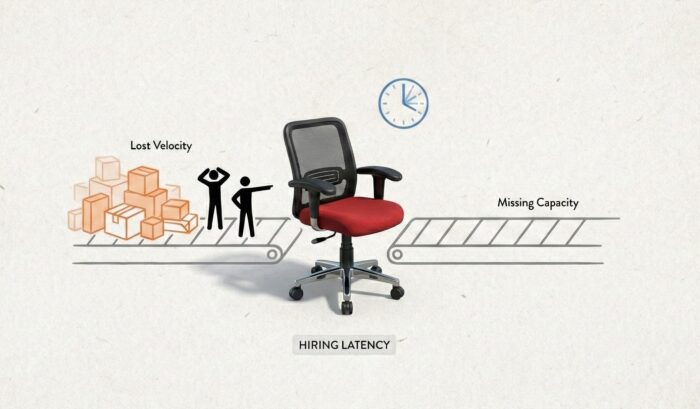
That delay has a name: hiring latency.
Beyond time-to-hire
Technology leaders have long treated recruitment as a human resources function, neatly separated from product delivery. This is a mistake that carries substantial hidden costs.
Most teams track time-to-hire and consider the matter closed. This is rather like tracking time-to-order while ignoring shipping, customs and onboarding. A more honest equation runs as follows: hiring latency equals time-to-hire, plus time-to-start, plus time-to-productivity.
A role is not “filled” when the offer is signed. It is filled when the organisation gains net new, reliable velocity.
The Danish reality check
Labour market data illuminate the scale of the problem. According to the Danish Agency for Labour Market and Recruitment (STAR), employers encountered difficulties in roughly one-fifth of recruitment attempts in the six months to November 2024. In approximately 10 per cent of cases, positions remained unfilled entirely. A further 12 per cent were filled by candidates lacking some desired qualifications.
These figures represent more than administrative inconvenience. For technology companies, they constitute delivery constraints that belong on project schedules rather than HR dashboards.
Vacancies as delivery debt
The mindset shift required is straightforward: vacancies are not HR work. They are product delivery debt.
And the debt is not linear.
A missing junior developer typically represents lost additive capacity – their output simply disappears from the schedule. A missing senior engineer, technical lead, engineering manager or platform specialist often creates multiplicative drag, blocking colleagues and extending cycle times across entire teams.
This distinction matters for planning purposes. Companies that model vacancies purely as linear capacity gaps systematically underestimate actual delays. One empty chair can stall five people.
A practical vacancy-cost model
A more rigorous approach need not require elaborate tooling. The following framework can be implemented within a single planning session.
First, estimate weekly contribution using whatever unit the team already trusts: story points, tickets, pull requests, or a measurable effect such as cycle time reduction.
Second, apply a bottleneck multiplier reflecting downstream impact. A factor of 1.0 suits independent contributors whose absence affects only their own output. A factor of 1.5 to 2.5 applies to roles that unblock others – senior backend leads, staff engineers, engineering managers, platform and site reliability specialists.
Weekly velocity loss equals contribution multiplied by the bottleneck factor. Dividing this figure by team velocity yields estimated schedule slip per week of vacancy.
This last calculation is the one that changes planning conversations, because it forces an uncomfortable question: if this role stays open for six more weeks, what actually happens to our dates?
Embedding hiring in the roadmap
If roadmaps are to reflect operational reality rather than serve as motivational posters, they require three fields for every critical role: a needed-by date marking when the role becomes a constraint; a latency budget specifying how many weeks of delay the plan can tolerate; and a productivity definition establishing what “useful” means – first meaningful pull request, on-call readiness, shipping a scoped feature.
A single key performance indicator can then track performance:
Hiring Latency Index = actual latency ÷ latency budget
A ratio below 1.0 indicates hiring supports the plan. Between 1.0 and 1.5 signals risk requiring scope cuts or interim capacity. Above 1.5 means the roadmap rests on missing foundations.
When vacancies become existential
A vacancy becomes existential when any of three conditions apply.
First, when it blocks a milestone carrying consequences — a funding narrative, an enterprise renewal, a regulatory deadline, a launch window.
Second, when it involves a multiplier role and cycle time worsens month-on-month. The system is degrading, not merely slowing.
Third, when the organisation resorts to expensive coping mechanisms: contractors, overtime, shortcuts, rising incident risk. These represent the hidden runway killers.
The STAR data should concentrate minds: in the period surveyed, roughly one in ten recruitment attempts ended with no hire, and a further 12 per cent landed a partial fit. Hope is not a staffing strategy.
The verdict
Hiring latency is a delivery metric wearing an HR costume.
Measure it as rigorously as uptime and cycle time — and the roadmap stops lying.